Decisional Integrity
From the documentation of the field
What must a decision-maker get right, structurally, to avoid failure under uncertainty?
This repository holds the documentation for the field of Decisional Integrity: the question, the definition, the argument, the standard for assessing it, and the evidence that motivates it. Every theorem here rests on Ismail's Primitives (V6.2) and is machine-verified in Lean 4 in the IsmailsPrimitives repository. The Dossier is an empirical synthesis, assessed separately. The author is Muhammed Ismail (ORCID 0009-0000-3713-7105).
The idea in brief
In a complex environment, a decision structure that lacks one of the six primitives of Ismail's Primitives incurs linear regret (the necessity result, proved in SixPrimitives/Phase3.lean): its loss grows in proportion to time. Decisional Integrity is the property a structure has when, in a Class C environment, it possesses all six. The theory is stated for a class of environments, Class C, which exhibits at least one of six structural situations.
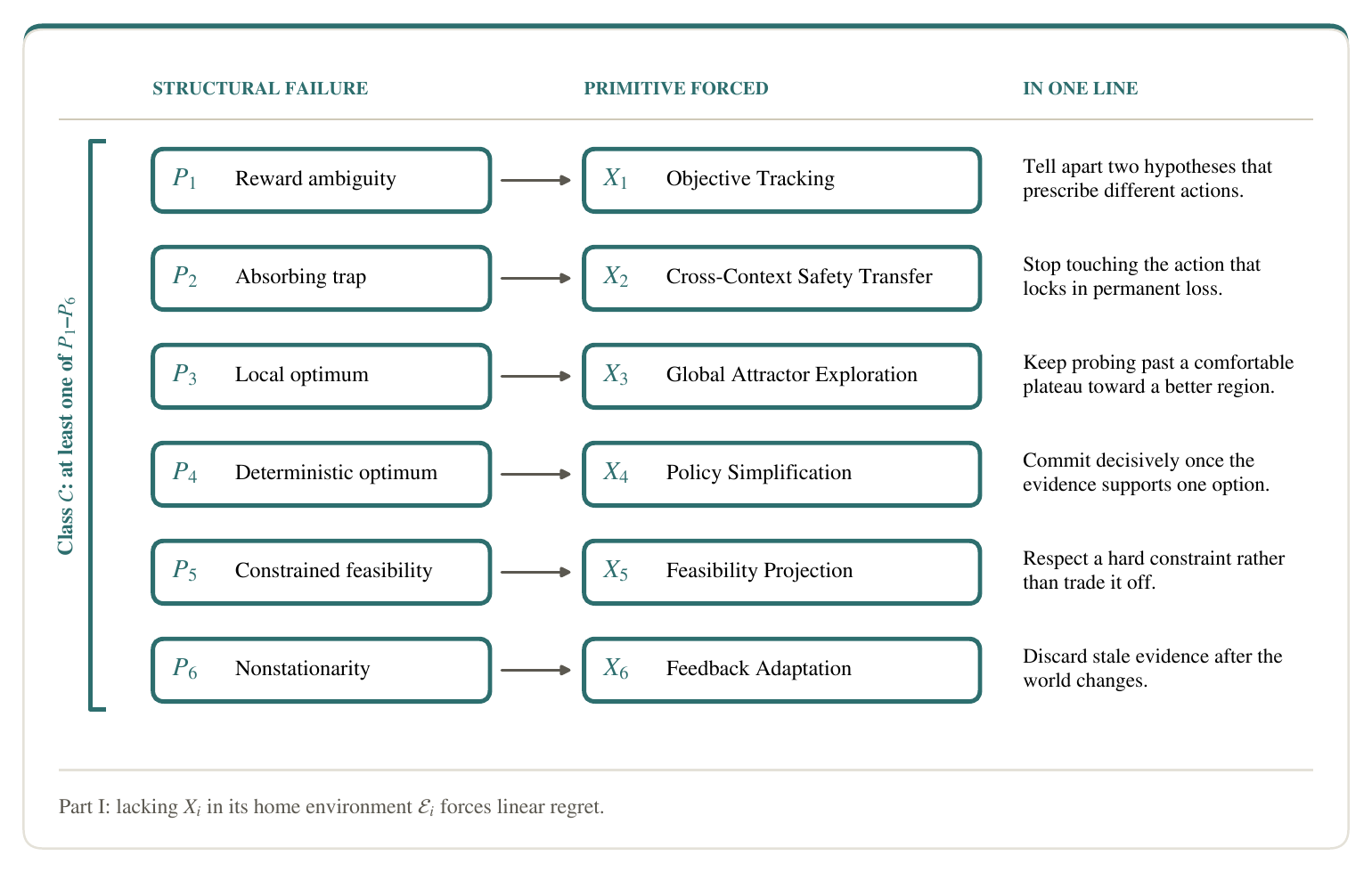
| Situation (P₁ to P₆) | Capability it needs (X₁ to X₆) | In plain terms |
|---|---|---|
| P₁ Reward ambiguity | X₁ Objective Tracking | Telling apart two explanations that call for different actions |
| P₂ Absorbing trap | X₂ Cross-Context Safety Transfer | Staying away from the kind of action that locks in permanent loss |
| P₃ Local optimum | X₃ Global Attractor Exploration | Continuing to probe beyond a comfortable plateau |
| P₄ Deterministic optimum | X₄ Policy Simplification | Committing once the evidence supports a single option |
| P₅ Constrained feasibility | X₅ Feasibility Projection | Treating a hard constraint as a wall that cannot be traded off |
| P₆ Nonstationarity | X₆ Feedback Adaptation | Discarding evidence that went stale when the world changed |
The paper proves three things about these six, and each is a separate part of the Lean project.
| Part | Result | Lean file |
|---|---|---|
| I | Necessity: lacking the matching capability forces linear regret in the environment that exhibits its situation | Phase3.lean |
| II | Independence: none of the six can stand in for another (thirty ordered pairs) | Phase4.lean |
| III | Sequential dependence: the six links of the cycle, conditional on stated hypotheses | Phase5.lean |
The claim is one of necessity. It is a floor that holds whatever the decision-maker wants. Sufficiency for any one organisation needs that organisation's own definition of success and case-specific work, as necessity and sufficiency sets out. A verdict from this field makes no forecast of success or failure.
The problem: the Dossier
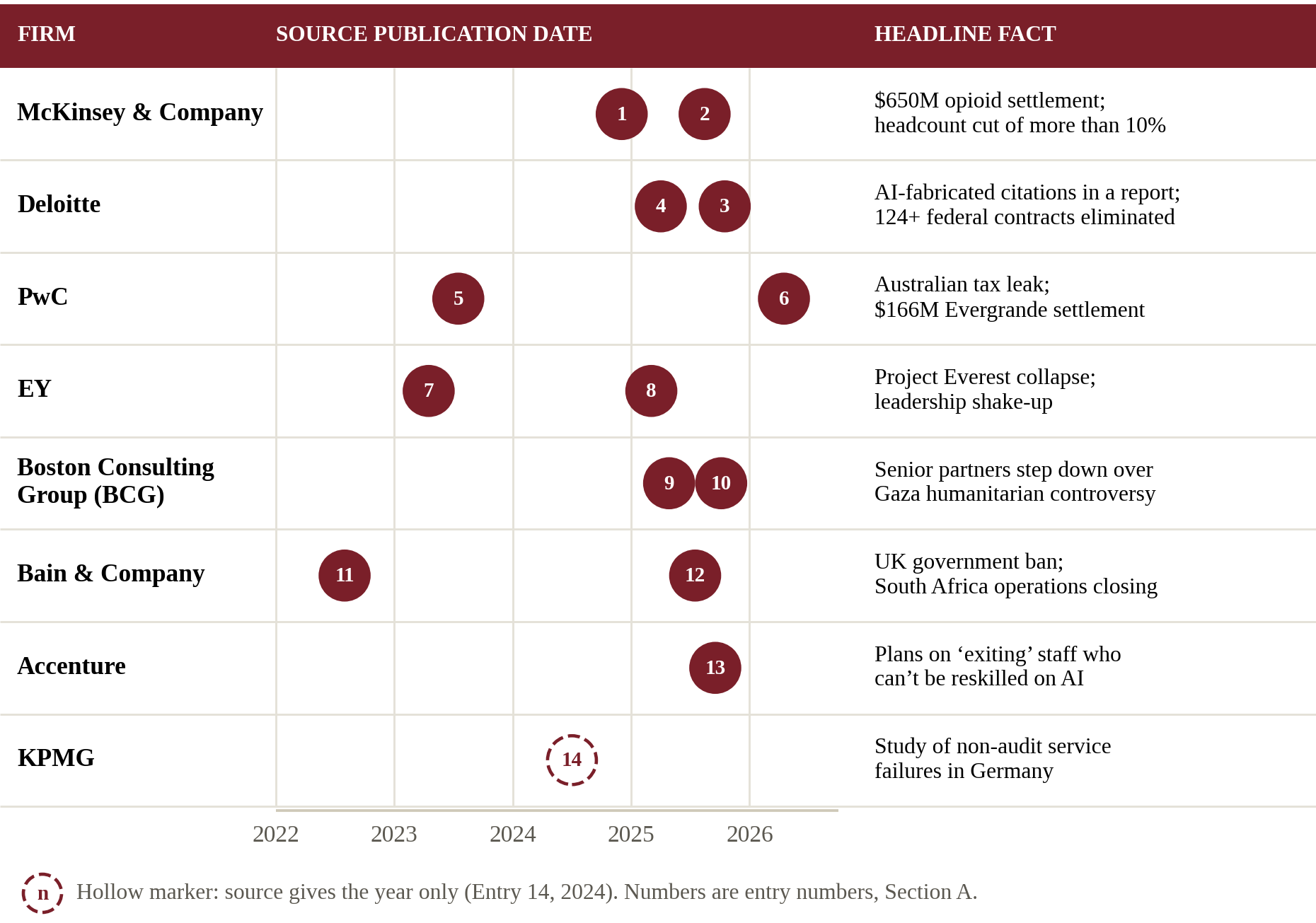
The Dossier, titled On Eroding Trust in Decision Firms, collects 26 articles, each given an independence rating, within an investigation window of August 2020 to August 2026, about eight consulting and audit firms and the industry around them: McKinsey & Company, Deloitte, PwC, EY, Boston Consulting Group, Bain & Company, Accenture and KPMG. It reads the pattern as predominantly structural and weights the causes at roughly 65% structural and 35% operational, as the proportion observed when the entries are classified by the kind of failure they describe.
The core findings, each developed in the Dossier:
- Accountability failures are firm-specific and recurring. Six of the eight firms (McKinsey & Company, Deloitte, PwC, Boston Consulting Group, Bain & Company and KPMG) have been implicated in at least one significant scandal between 2020 and 2026.
- The audit-consulting conflict is structural. Advisory fees now exceed audit fees across the Big Four ($77 billion against $53 billion globally).
- AI puts pressure on the billable-hour model. In an IBM-sponsored survey, 65% of surveyed executives said traditional consulting no longer delivers value.
- Government contract cuts compound the pressure, for example more than 120 Deloitte contracts worth over $1.1 billion eliminated under DOGE.
- The industry is bifurcating, with specialised boutique firms reportedly entering a strong growth period (Entry 24).
If the pattern is structural, who erred is no longer the most useful question. The Dossier supplies the reason to ask the core question above and stops short of answering it.
| Part of the Dossier | What it holds |
|---|---|
| Sections A to D | Firm-specific scandals, industry-wide erosion, independent and academic assessments, and counter-narratives |
| Thematic analysis | Five themes: the audit-consulting conflict, AI and the billable-hour model, government contract vulnerability, reputational contagion, and the bifurcation thesis |
| Root-cause analysis | The structural versus operational weighting and its counter-evidence |
| Appendices | Methodology and source standards, the source directory, and additional sources reviewed |
| Entries | One page per article (01 to 26), each with a summary, a source description and a credibility assessment |
The answer: the field pages
The field pages set out the question, the definition and the argument. They can be read in order.
| Page | What it covers |
|---|---|
| The question | The question the field asks, and how the Dossier leads to it |
| Field definition | The object (a decision structure), the six situations and capabilities, Class C, and what kind of verdict the field supports |
| Class C | The boundary of the claims, why they are conditional, and how the boundary can be tested and challenged |
| Why a POMDP | The model behind the claims and why its range from trivial to precise is its strength |
| Necessity and sufficiency | Parts I to III of the paper, and why necessity is a floor and sufficiency a ceiling |
| Verification tiers | What Lean 4 checks, what can be counted, and the four tiers of support for the field's claims |
| Audit it yourself | A route through the code for a reader who wants to evaluate the checks directly |
| Methodologies | Ten familiar methods (SWOT, OODA, MECE, stage gates, pre-mortems, RAID logs, Monte Carlo, scenario planning, Six Sigma, Agile) related to the six primitives |
| Competence | What it takes to assess a real structure or extend the results, and how a person shows it |
| Error theory | Four ways an assessment goes wrong: Class C misclassification, mechanism misidentification, scope creep and sampling error |
| Three-party verification | Lean verifies Ismail, Ismail verifies the application, and the client verifies that the two agree |
| Adjacent fields | Decision quality, ISO 31000 and COSO ERM, assurance engagements, safety cases and industrial formal methods |
How an answer is assessed: the standard
The standard states what it means for a decision structure to possess each of the six primitives, and what a verdict on that does and does not say. It is the modular check of the theory against a real structure, one primitive at a time. It rests on the general criteria, which say what counts as evidence and how a mechanism that performs a function is told from an artefact that resembles one, and on one criteria page per primitive.
| Primitive | Criteria page |
|---|---|
| X₁ Objective Tracking | X1 criteria |
| X₂ Cross-Context Safety Transfer | X2 criteria |
| X₃ Global Attractor Exploration | X3 criteria |
| X₄ Policy Simplification | X4 criteria |
| X₅ Feasibility Projection | X5 criteria |
| X₆ Feedback Adaptation | X6 criteria |
A verdict is given primitive by primitive, at one of three levels: lacking, ordinarily possessing or robustly possessing. It is a finding on evidence about whether a mechanism that performs the function exists and operates. The standard states criteria and leaves methods of gathering evidence to those who carry out an assessment.
Tools used on this site
Every page is run through two protocols before it is published. Both are packaged as Claude Skills in the IsmailsProtocols repository.
- Review discipline describes how the site checks its own writing. It says nothing about any organisation's decision structure.
- Ismail's Credibility Checker is an eight-rule protocol for judging whether a claim, theory, study or source is well supported, separating validity from prestige and credentials.
- Ismail AI Review is a 21-rule house-style checklist for finding and removing the fingerprints of AI writing, adapted from Wikipedia's Signs of AI writing (CC BY-SA 4.0).
About the author and the applications
- Author and priority is the one full account of authorship and priority. It lists what can be checked, with the Lean project (12,667 lines across seven files, with zero
sorry, zeroaxiomand zeroopaque), the Mathlib glossary and the protocols, and it claims no authority from credentials or affiliation. - Applications lists the companion papers that apply the same primitives in economics, human development, emotional adaptation in therapy and the SPEA clinical protocol.
Where to start
| If you want to | Read |
|---|---|
| See why the question matters | The Dossier, then the question |
| Understand the claim in full | Field definition, then necessity and sufficiency |
| Check where the claims stop | Class C and error theory |
| Check the mathematics yourself | Verification tiers and audit it yourself |
| Assess a real structure | The standard and the six criteria pages |
| Relate it to methods you already use | Methodologies and adjacent fields |
| Judge the sources and the writing | Review discipline |
References and licences
The references page lists the primary paper, the Lean 4 repository, the companion papers, the tools and the other sources, each with an identifier and a note on where the site uses it. The primary paper is licensed CC BY 4.0, and the Lean code in the repository is licensed MIT.