Thematic analysis
From the Dossier
Thematic Analysis
Theme 1: The audit-consulting conflict of interest
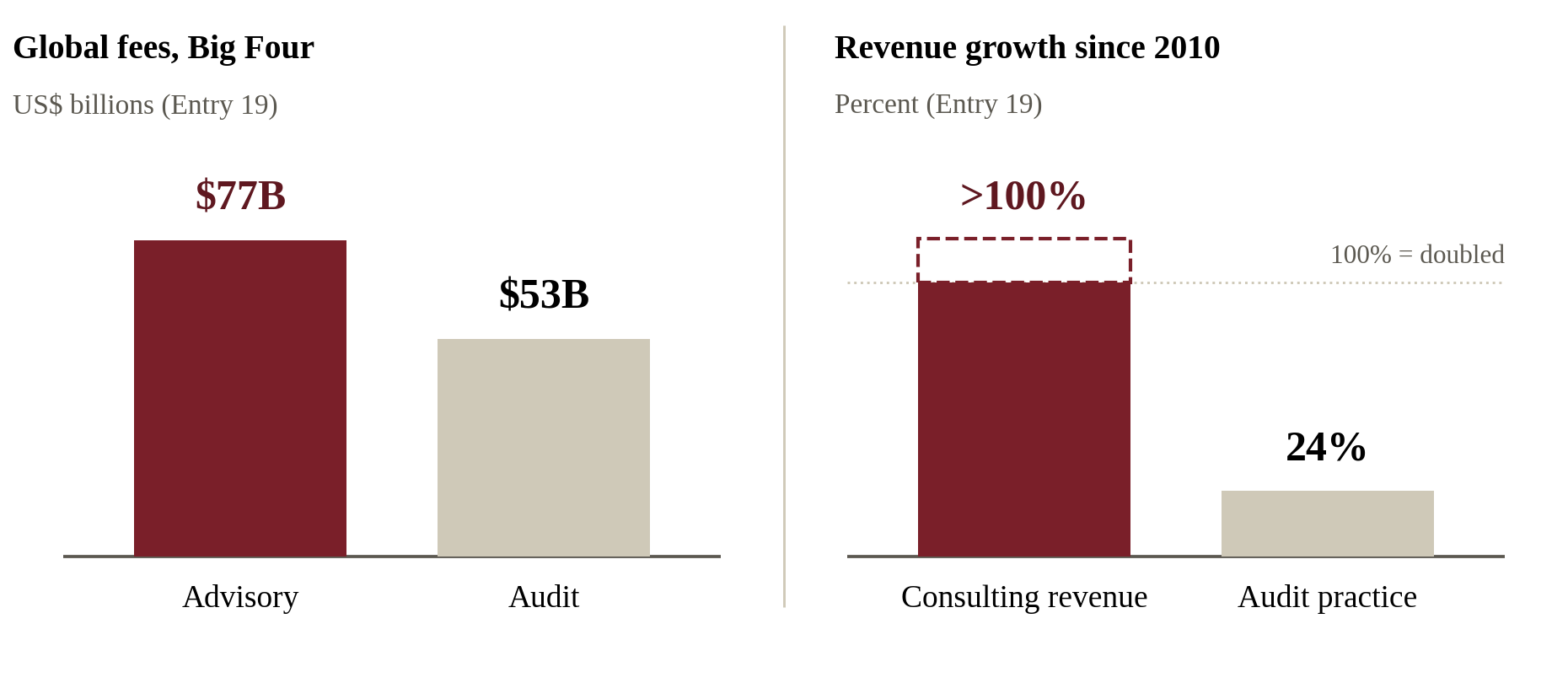
The structural conflict between audit and consulting is a main driver of eroding trust. Revenue data makes the incentive clear: consulting now accounts for nearly half of Big Four revenue, far outpacing audit growth. Rowe warned that the culture itself could deteriorate to the point of “large scale frauds again”.
Friedrich and Quick’s study of KPMG Germany supports this concern: it found that while audit clients suffered negative market reactions after non-audit service failures, KPMG itself did not face significant consequences. Friedrich and Quick’s KPMG Germany study suggests reputation does not discipline Big Four firms, a finding that undermines the industry’s claim that market forces provide adequate accountability.
The Conversation’s analysis frames the problem precisely: auditors are meant to scrutinize clients’ finances independently, but the consulting arm depends on those same clients for far more lucrative fee income. The incentive is not to look too closely. EY’s failed Project Everest split was an attempt to address this structurally, but it collapsed due to internal conflict over how to divide the spoils.
Theme 2: AI and the billable-hour model
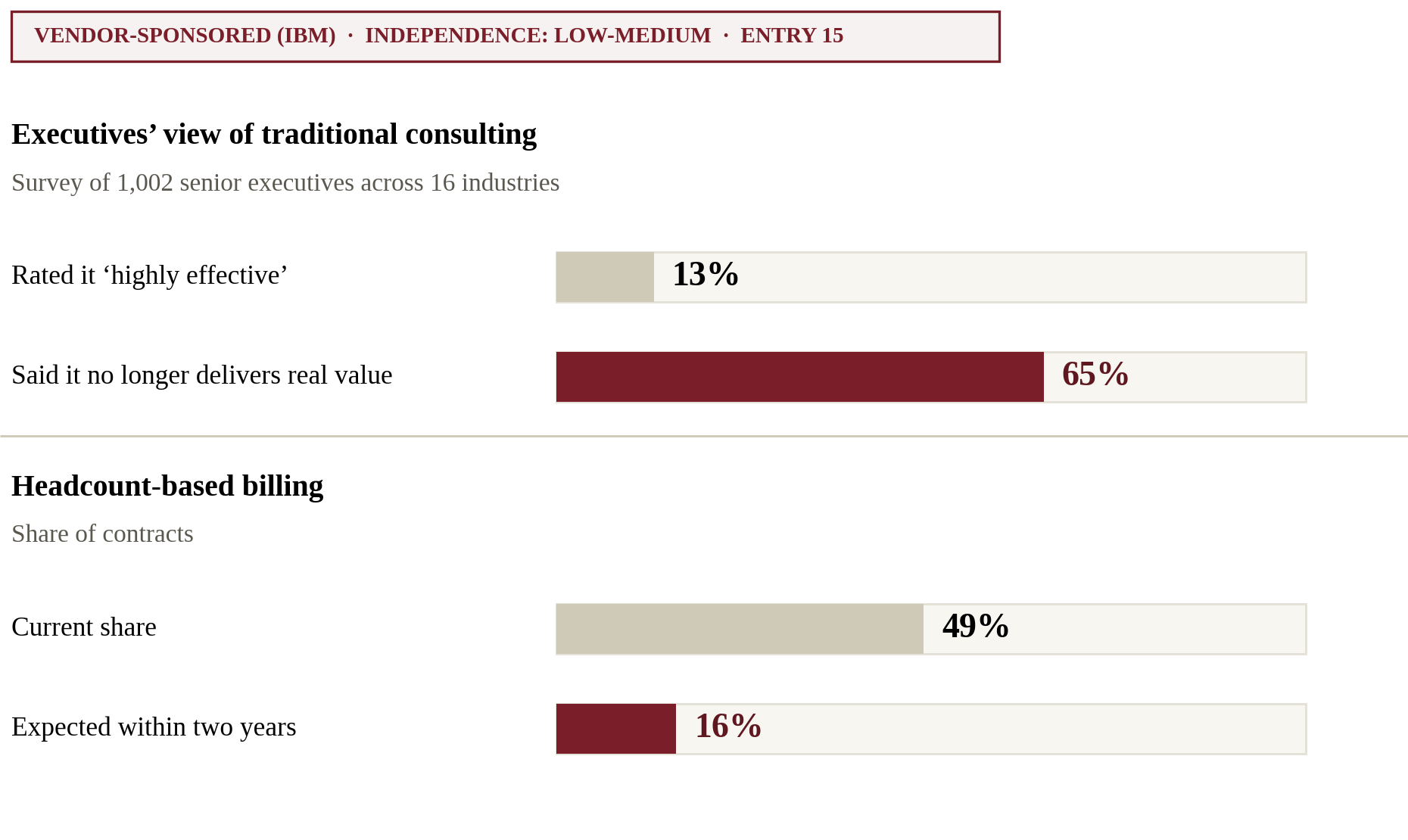
The consulting industry’s billable-hour model is fundamentally incompatible with AI-driven efficiency. As Rodenhauser put it, a firm that charges for time has to change its commercial model once the time goes away. The WSJ’s reporting documents that clients are already souring on AI consulting engagements: Bristol-Myers Squibb ended a year-long engagement for lack of progress, and Merck’s CIO described consultants “learning on our dime”.
The HFS/IBM survey finding that 65% of enterprises say traditional consulting no longer delivers value, while vendor-sponsored, is consistent with the broader pattern of client dissatisfaction. The industry’s response, as articulated in the HBR piece, is to argue that AI will reshape rather than replace consulting. But this argument comes from insiders with commercial stakes in that conclusion.
The economic logic is stark: if AI makes consulting work faster and the industry charges by the hour, efficiency directly reduces revenue. Rodenhauser also observed that AI is making consulting more efficient without driving demand for more of it, so the firms will eventually “run out of work”.
Theme 3: Government contract vulnerability
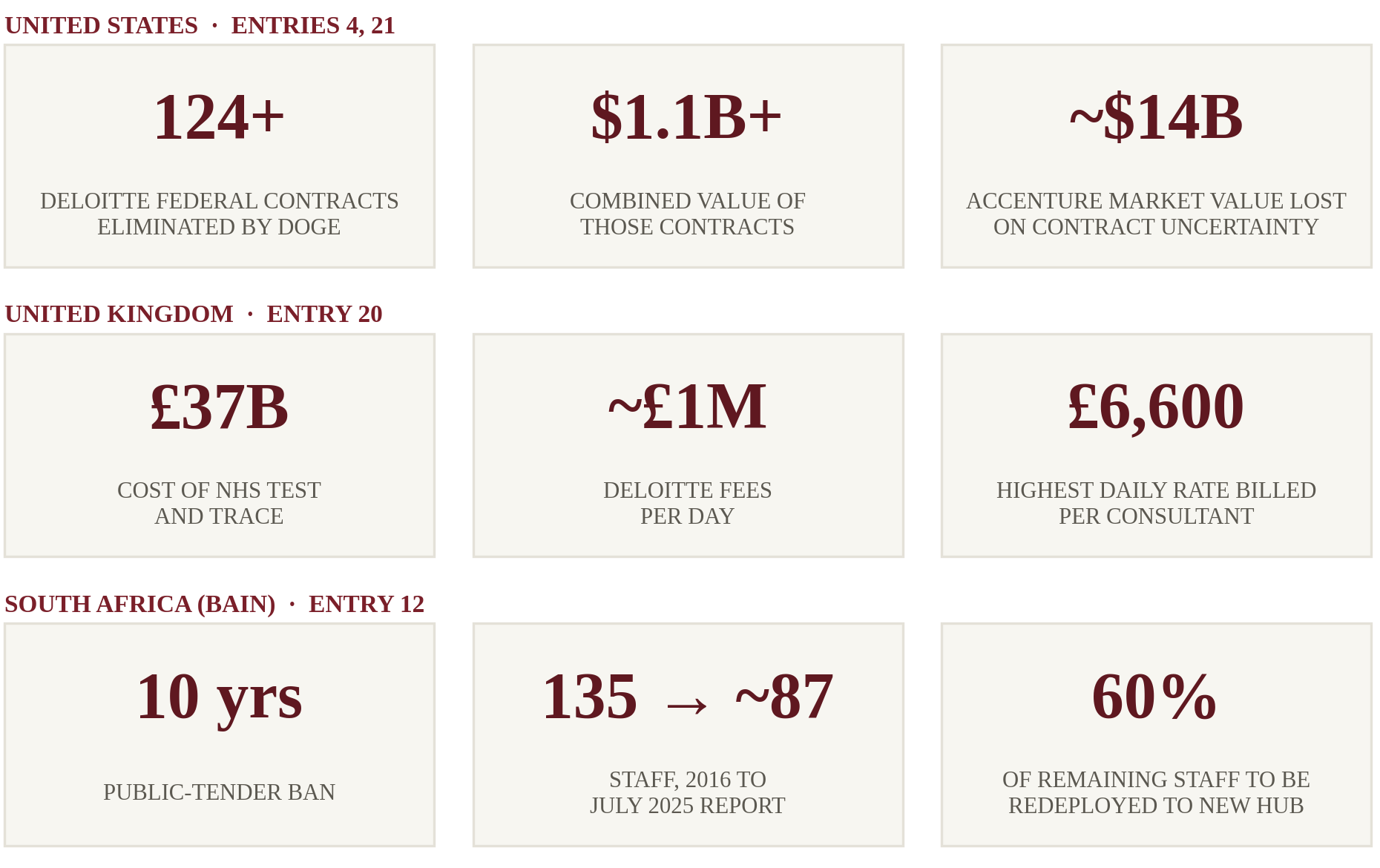
Government contract cuts are the second major pressure point. The DOGE initiative eliminated more than 120 Deloitte contracts worth over $1.1 billion, and Accenture lost approximately $14 billion in market value on federal-contract uncertainty.
The UK’s Test and Trace scandal shows the same dynamic in a different national context: £37 billion spent without demonstrable results, consultants paid up to £6,600 a day, and the government then hiring consultants to defend against criticism.
Bain’s South African closure is the most extreme outcome of government sanction: a ten-year public-tender ban that the firm’s business “never fully recovered” from. The firm’s South African office fell from 135 staff to roughly 87, with most redeployed to a global-services hub.
Theme 4: Reputational Contagion
Friedrich and Quick’s academic study tests whether reputational contagion between consulting and audit arms is real or assumed. Their finding, that KPMG did not face significant consequences even as its audit clients did, suggests the reputational damage is contained within client relationships.
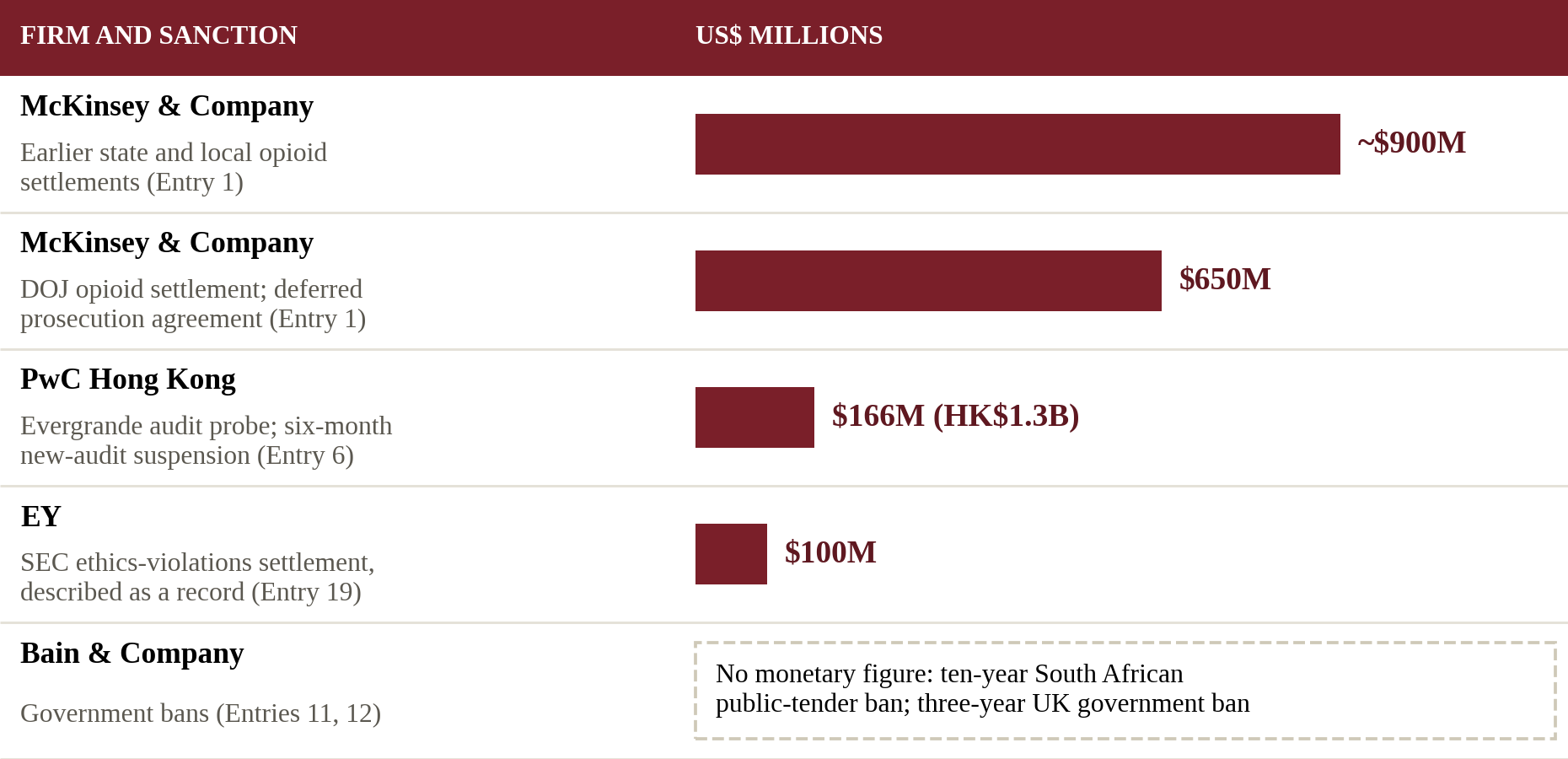
This has implications for the trust-erosion thesis. If reputational damage does not spread, firms can absorb scandals in one service line without losing business in another. The PwC Evergrande settlement and McKinsey opioid settlement are large financial penalties, but neither appears to have fundamentally threatened the firms’ viability. This suggests the industry’s business model is resilient to scandal.
Theme 5: The bifurcation thesis
The counter-narrative argument, that “consulting” is two distinct markets (Entry 24), has empirical support. Large management-consulting giants are indeed vulnerable to AI and federal cuts. But specialized boutique firms serving government and nonprofit clients on governance and policy work may be entering a growth period.
This is consistent with the broader pattern: the problem lies in the specific business model of the large management-consulting firms (billable hours, pyramid structures and the audit-consulting conflict). The industry may be fragmenting, with the large firms losing market share to more specialized and more accountable competitors.
| The Dossier | |
|---|---|
| Pages | OverviewEvidence: Sections A to DThematic analysisRoot-cause analysisAppendix A: Methodology and source standardsAppendices B and C: Sources |