Root-cause analysis
From the Dossier
Root-cause analysis: Structural vs. operational failure
Based solely on the evidence compiled in this dossier, the balance tilts toward structural decision failure as the primary driver, with operational failures functioning as the inevitable symptoms of those broken structures.
The evidence supports a narrative of deliberately chosen business models and governance strategies that systematically incentivize operational failure and immunize firms against its consequences.
The breakdown below sorts the evidence by root cause.
1. Structural decision failures (The root cause)
These are decisions made at the board, global executive, or partnership level regarding what the firm sells, how it gets paid, and who it serves. The dossier’s evidence indicates that these strategic choices are the foundation of the crisis.
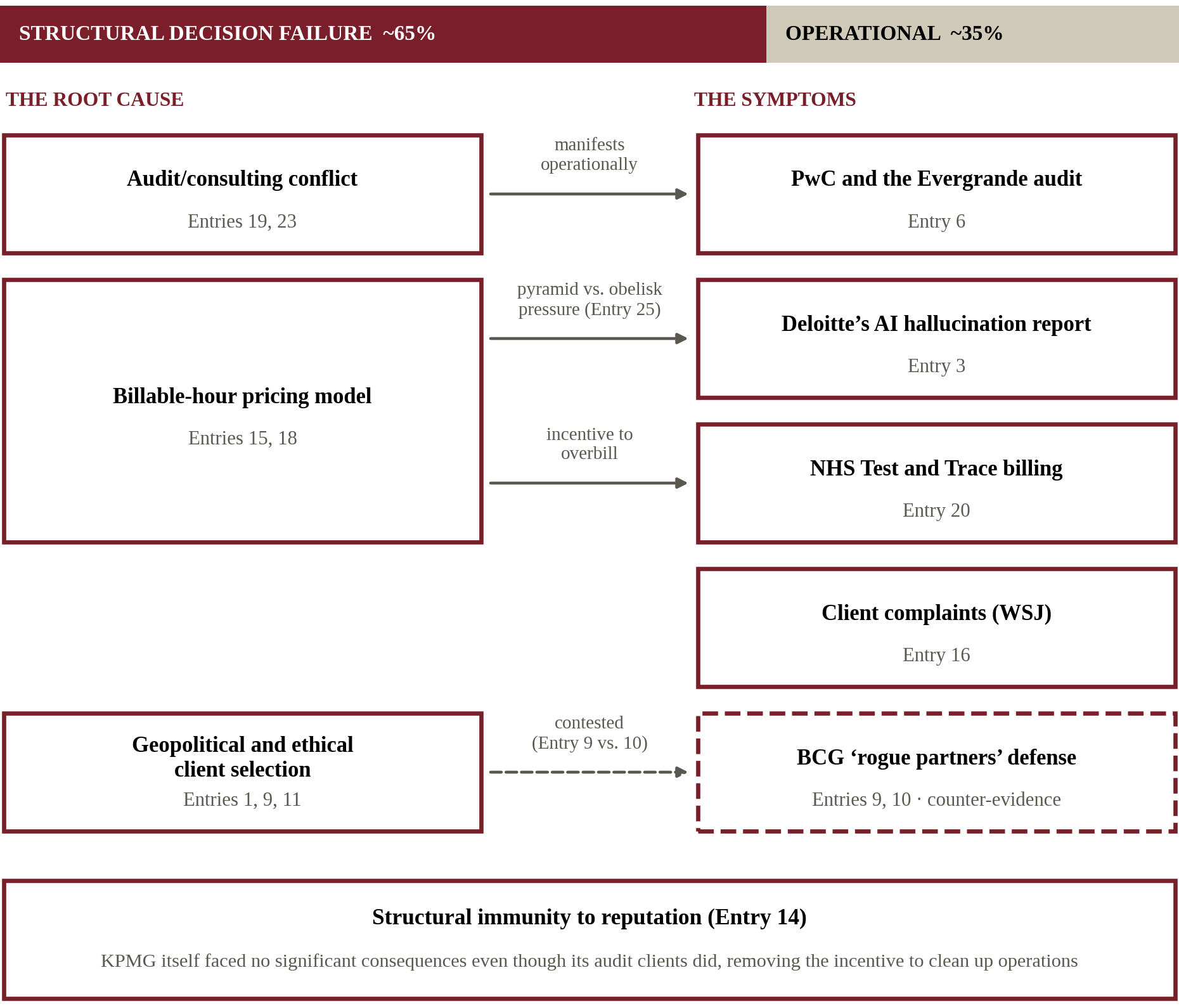
The Audit/Consulting Conflict (Entry 19, 23): This is a clear structural failure. The Big Four strategically chose to grow their consulting arms (now nearly 50% of revenue, $77bn vs. $53bn for audit) while maintaining the audit relationship. This is a business model that creates a structural incentive to overlook client fraud (as seen with PwC/Evergrande) to protect lucrative advisory fees. The collapse of EY’s Project Everest (Entry 7) shows that partners could not agree on how to untangle the audit-consulting conflict without financial self-harm.
The Billable-Hour Pricing Model (Entry 15, 18): Charging by the hour when AI exponentially increases efficiency is a structural commercial failure. As analyst Tom Rodenhauser states in Entry 18, a firm that charges for time has to change its commercial model once the time goes away. The industry’s continued adherence to this model, despite 65% of clients saying it delivers no value, is a strategic refusal to adapt.
Geopolitical and Ethical Client Selection (Entry 1, 9, 11): The decision to take on contracts with Purdue Pharma (opioids), the South African state-capture regime (Bain), and the Gaza relocation modeling (BCG) were high-level strategic bets on high-risk, high-fee clients. In McKinsey’s case, federal prosecutors stated the firm “knowingly and intentionally” advised Purdue on sales strategies. This is calculated strategy.
Structural Immunity to Reputation (Entry 14): The peer-reviewed KPMG study provides evidence that when non-audit (consulting) failures occur, the firm itself faces no significant capital-market consequences, even though clients suffer. Structurally, reputational damage does not spread to the bottom line, removing any strategic incentive to clean up operations.
2. Implementational/operational failures (The symptoms)
These are failures of execution, quality control, and day-to-day delivery by project teams. The dossier contains clear instances of this, but importantly, they are almost always directly triggered by the structural failures above.
Deloitte’s AI Hallucination Report (Entry 3): Using generative AI to draft a government report without verifying citations, leading to fabricated court cases and academic references, is an operational/quality-assurance failure.
NHS Test & Trace Waste (Entry 20): Billing the UK government £6,600 per day for individual consultants while failing to reduce infection rates is an operational delivery failure (and a procurement failure on the client side).
WSJ Client Complaints (Entry 16): Merck’s CIO explicitly states consultants were “learning on our dime.” This is operational incompetence: selling AI expertise the firm did not yet possess.
3. The causal link: How structure drives operations
The evidence suggests the operational failures derive from the structural ones:
The “Pyramid” vs. “Obelisk” Pressure (Entry 25): The traditional structural model relies on large numbers of junior consultants doing heavy lifting. When AI is introduced to speed up this grunt work (the HBS/BCG experiment showing 25% faster tasks), the structural pricing model (billable hours) breaks, but simultaneously, the operational pressure to use AI without verification (Deloitte) rises to maintain margins.
The Conflict of Interest manifests operationally (Entry 6): PwC didn’t just make an arithmetic error on Evergrande; regulators said it “turned a blind eye” to a 564-billion-yuan fraud. The structural reliance on Evergrande as a consulting client directly corrupted the operational execution of the audit.
4. The counter-evidence (Where operations stand alone)
The dossier also shows operational failure without a clear structural mandate:
The BCG “Rogue Partners” Defense (Entry 9): BCG insists its Gaza modeling was done by two partners who “went rogue” and carried out unsanctioned work. If true, this is purely operational and governance failure within a specific team, not a board-level strategy. However, the Carnegie analysis (Entry 10) questions this, arguing the firm’s operating model allowed them to shape the foundation’s model, suggesting structural oversight failures.
Objective Weighting Conclusion
Based strictly on the verified entries in this dossier:
| Category | Weight | Evidence basis |
|---|---|---|
| Structural Decision Failure | ~65% | The audit/consulting revenue model, the billable-hour pricing inertia, the calculated client-selection risks, and the academic evidence that reputation does not discipline firms (Entry 14). These are choices made in boardrooms. |
| Implementational/Operational Failure | ~35% | The AI hallucinations, inflated daily billing rates for ineffective work, and poor QA on specific deliverables. |
The ultimate verdict of the evidence: The operational failures (hallucinated reports, wasted tax money, poor AI delivery) are the visible symptoms. The structural failures (conflicted business models, perverse pricing incentives, and a market that refuses to punish scandal) are the cause.
If the structural model were fixed (i.e., separating audit from consulting and abandoning the billable hour), the operational incentives to cut corners with unverified AI and overbill for mediocre work would diminish significantly. Fixing operations alone would not save the industry, because the structure is what makes the firms immune to the consequences of their operational blunders.
Because the weighting places the fault in structure rather than execution, the question the evidence raises is what a decision-maker must get right, structurally, to avoid failure under uncertainty; the Conclusion returns to it.
Conclusion: The state of eroding trust
The evidence assembled in this dossier supports one conclusion: trust in the large management-consulting firms is eroding on several fronts, and the erosion appears structural. Six of the eight major firms have been implicated in a significant scandal between 2020 and 2026. The Root-Cause Analysis weights the failures at roughly 65% structural decisions and 35% operational execution. The convergence of accountability failures, structural conflicts of interest, AI-driven economic pressure and government reassessment puts the business model (billable hours, pyramid structures and the audit-consulting conflict) under pressure from several directions.
The core question: This dossier documents a pattern (eight major firms, six years, a recurring set of failure modes), and the Root-Cause Analysis finds it to be predominantly structural rather than operational, at roughly 65% to 35%. That changes the question the evidence poses to:
The core question
What must a decision-maker get right, structurally, to avoid failure under uncertainty?
The dossier does not test remedies and does not claim to answer that question. It does show where the answer must be found: whether the function that assures is independent of the function that sells (Entries 19, 23); whether the pricing model survives its own efficiency gains (Entries 15, 18); whether client-selection risk is governed where the decision is made (Entries 1, 9, 11); and whether consequences reach the decision-maker or are absorbed elsewhere (Entry 14). What can be said on the evidence alone is that the pattern is too consistent, and too costly, to dismiss as unrelated bad luck.
| The Dossier | |
|---|---|
| Pages | OverviewEvidence: Sections A to DThematic analysisRoot-cause analysisAppendix A: Methodology and source standardsAppendices B and C: Sources |