Appendix A: Methodology and source standards
From the Dossier
Appendix A: Methodology and source standards
A.1 Credibility assessment protocol
This dossier applies Ismail’s Credibility Checker, an eight-rule protocol, to all claims carrying evidentiary weight:
-
Assume the null position: Claims assessed as untested hypotheses until evaluated
-
Separate the medium from the message: Content evaluated, not packaging
-
Audit the definitions: Claims only as good as whether definitions map onto what is actually claimed
-
Establish the hierarchy of verification: Deductive claims can reach formal proof; inductive claims reach consilience
-
Recognize social signals as marketing, not truth: Citation counts, journal prestige, author affiliation measure attention, not accuracy
-
Institutions do not confer infallibility: Credentials are evidence of training, not absence of error
-
Burden of proof: Whoever asserts a claim carries the burden of supporting it
-
Maintain epistemic agility: Methods change; standards are revisable
A.2 Excluded Material
Under the protocol in A.1, the following were excluded:
-
Generic “70% of projects fail” statistics: Fail Rule 3 (Audit the Definitions): they measure project management outcomes generally, not consulting-engagement outcomes specifically
-
Speculative future-dated article (“BCG Drops Billable Hour as AI Dismantles Consulting Pyramid”): Failed Rule 1 outright: described events in 2029-2031 as though they had already occurred
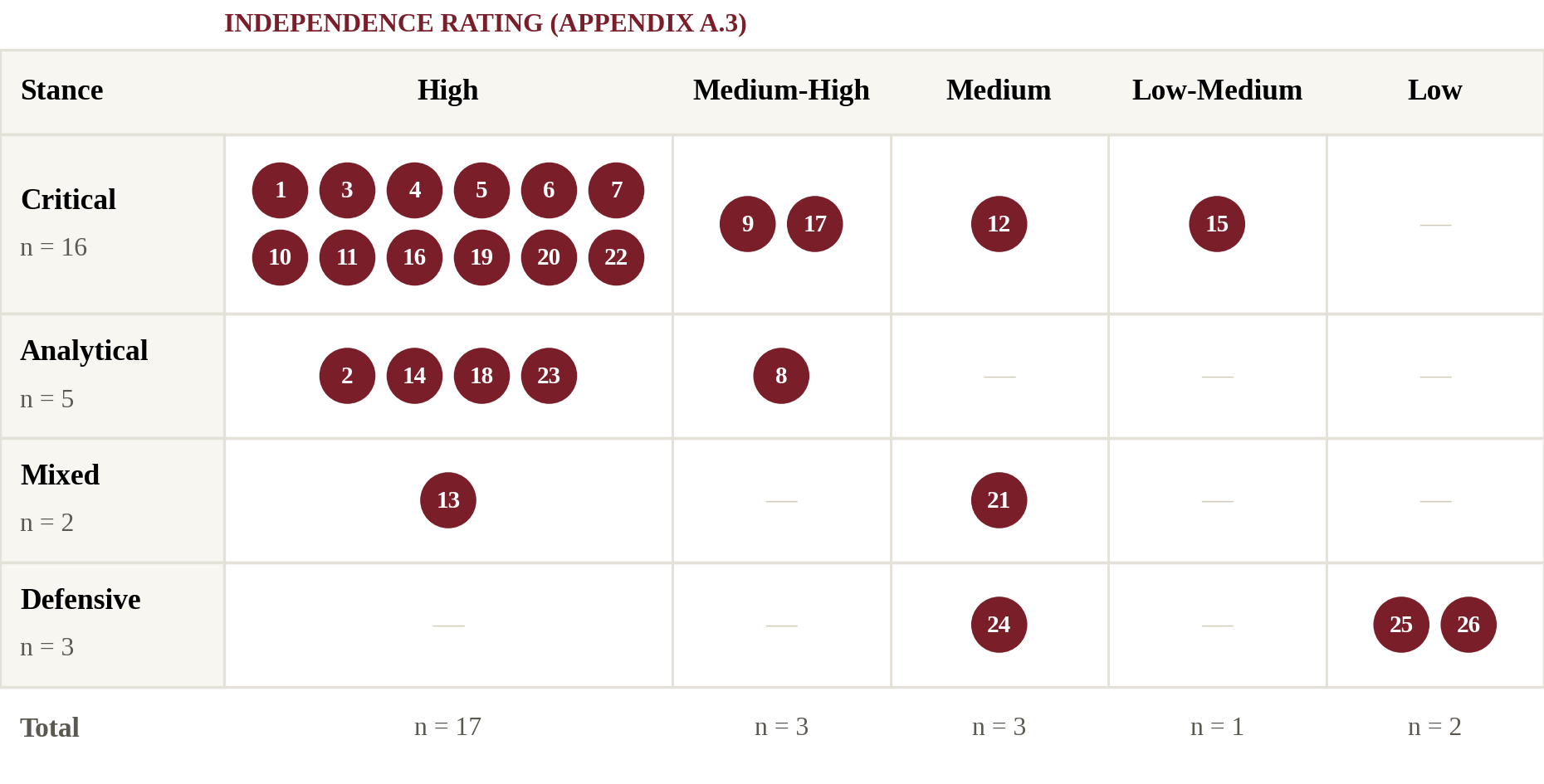
A.3 Independence ratings (Dossier)
| Rating | Definition | Examples |
|---|---|---|
| High | Wire service, peer-reviewed journal, nonprofit investigative consortium, no consulting-industry ties | NPR, WSJ, ICIJ, Carnegie, peer-reviewed academic journals |
| Medium-High | Mainstream business outlets, independent journalists with editorial oversight | Fortune, Business Insider, The Free Press |
| Medium | Trade publications, single-author newsletters, African business news | Consultancy.uk, Cultural Currents, Ecofin Agency |
| Low-Medium | Vendor-sponsored research with real data but directional interest | HFS/IBM survey |
| Low | Industry-insider contributed content with commercial stake | HBR (co-authored by consultant), Forbes Business Council |
A.4 Source list compilation notes
Each entry in the source directory (Appendix B) was retrieved via live web search and cross-verified against at least one additional outlet where underlying facts (settlement amounts, dates, headcount figures) permitted corroboration. Two fields extend beyond the basic format:
-
Sentiment status: categorizes each piece’s stance: Critical, Investigative, Analytical/Neutral, Mixed, or Defensive/Counter-narrative. Section D contains pieces that argue consulting is not experiencing terminal decline, providing balance against the “consulting is collapsing” thesis.
-
Independence rating (High / Medium / Low): assesses source independence. A piece written or commissioned by a consulting firm, its vendor partner, or a sitting consultant receives a lower score than wire service reporting, peer-reviewed journals, or journalists without industry ties.
A.5 Additional credibility notes
-
The HFS Research/IBM “65% of enterprises say consulting no longer delivers value” statistic (item 15). This meets Rule 4 as a legitimate inductive claim (a survey of 1,002 executives) but triggers Rule 6 (Institutions Do Not Confer Infallibility): the study was commissioned and sponsored by IBM, which sells AI-driven alternatives to traditional consulting that the finding validates. This does not disqualify the data, but the sponsorship context should be noted when citing the figure.
-
Generic “70% of projects fail” statistics appearing in consulting-industry commentary (PM360 Consulting, Workamajig, and similar project-management blogs). These fail Rule 3 (Audit the Definitions): they measure project management outcomes generally, not consulting-engagement outcomes specifically, and citation chains lead to recycled blog posts about consulting. These were excluded from the list to avoid misrepresenting what was actually measured.
-
A speculative future-dated article (“BCG Drops Billable Hour as AI Dismantles Consulting Pyramid,” disruptivitytimes.com) described events in 2029–2031 as though they had already occurred. This fails Rule 1 outright (it is not a claim about the world as it stands) and has been excluded entirely; it reads as speculative business fiction, not reporting.
-
The Big Con’s core thesis (item 22), that consulting reliance erodes public-sector capacity, is an inductive, paradigm-level claim. Per Rule 4, its evidentiary ceiling is consilience (converging case studies). The book supports its argument with case-study convergence (HealthCare.gov, COVID procurement, multiple national governments), which is appropriate for a claim of this scope.
| The Dossier | |
|---|---|
| Pages | OverviewEvidence: Sections A to DThematic analysisRoot-cause analysisAppendix A: Methodology and source standardsAppendices B and C: Sources |