Necessity and sufficiency
From the documentation of the field
The two claims this field could make about a decision structure are different in kind, and keeping them apart matters throughout the field. Failure has one shape. Success has none.
An algorithm either has the structural property that survival requires or it does not. If it does not, and its environment contains the matching difficulty, the outcome is loss that grows in proportion to time, whatever else the algorithm does well and however success is defined. Success has no comparable single shape. What sufficiency looks like depends on the environment, on the goal, and on choices that no necessity argument can make on anyone's behalf. That asymmetry fixes how the research is organised, and it fixes what this site claims.
What necessity says
In a complex environment, a structure that lacks one of the six primitives of Ismail's Primitives incurs linear regret (the necessity result, proved in SixPrimitives/Phase3.lean). The proofs are the smallest, most modular environments that show this. For each of the six situations, the paper builds a minimal environment that exhibits that one situation and nothing else, and proves that any algorithm lacking the matching capability suffers linear regret there. Regret is the running gap between what the algorithm has captured and the best that was achievable. Linear regret means the gap grows in proportion to time, so the shortfall per step never shrinks to zero however long the process runs.
These are six separate theorems, one per primitive of Ismail's Primitives, and they are unconditional in the sense that matters: necessity closes the moment the structural failure is granted. It needs nothing about the algorithm's aims beyond surviving that failure. How the proofs relate to the theory is set out on the field definition page. The minimal environments are the simplest case, and the result carries to any larger environment containing the same difficulty by a standard reduction used throughout the lower-bound literature.
Regret describes a gap, not a score for the latest period. A process lacking a required capability can post steady, positive results for a long time while the gap grows underneath. In the witness environment behind X₂, each step before the trap closes pays as normal, so an algorithm that occasionally takes the irreversible action looks fine until it is caught. In the witness behind X₆, an out-of-date strategy keeps earning a positive return, only a smaller one than the best available. A quiet period says nothing about whether the gap has stopped growing.
What independence says
The second result is that the six capabilities do not substitute for one another. For each ordered pair of different primitives of Ismail's Primitives, an algorithm built to survive the failure behind one primitive is redeployed in the home environment of the other, and it is shown to lack the second. There are thirty such pairs, which cover every off-diagonal cell of a six-by-six grid. A single master theorem, mutual_independence, states all thirty.
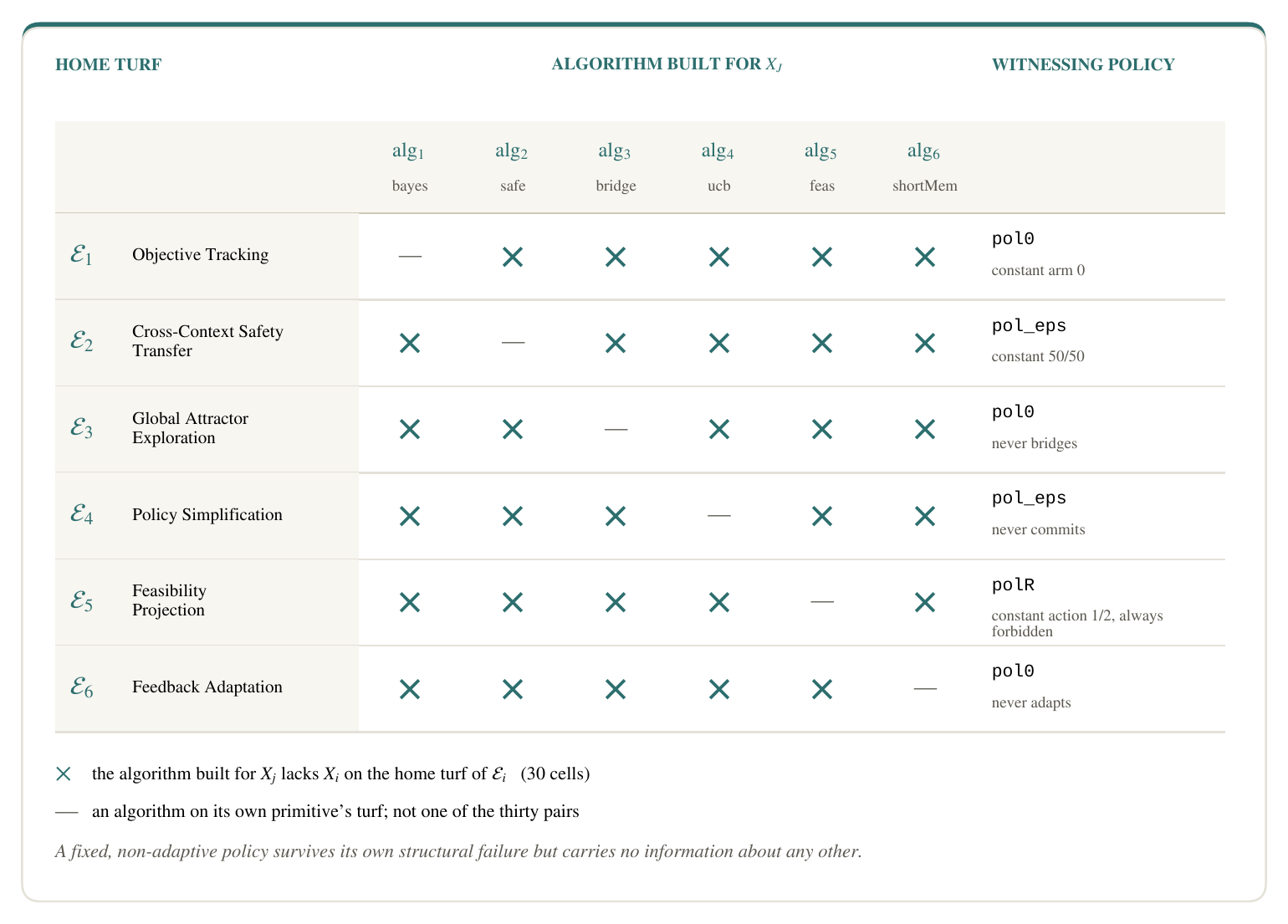
The result follows from a simple observation (see Ismail's Primitives). Each primitive's own structural failure can be survived by some fixed, non-adaptive policy. A fixed policy carries no information about which environment it is in. That is exactly the kind of algorithm Part I already shows cannot survive any of the other failures. So the independence proofs need no new constructions, and they establish that strength in one capability cannot be traded for a missing one. Like Part I, they are proved for the minimal witness environments.
What sufficiency would need
Part III asks the next question: given that all six (Ismail's Primitives) are required and none can stand in for another, how do they fit together in a process that works? Its answer is a formally-verified bridge towards sufficiency.
The six capabilities form a directed cycle, from X₁ to X₂ and on to X₆, which closes back to X₁. Each link is established by three results. A forward theorem shows that, under stated structural hypotheses, possessing one capability moves the information the process holds about its goal toward the maximum. A reverse theorem shows that, under a named bridging hypothesis connecting the failure of that capability to loss of information, the information the process can hold is strictly below the maximum. A non-reversibility result gives a fully concrete construction showing that satisfying the next capability's measure without the current one is achievable but informationally hollow.
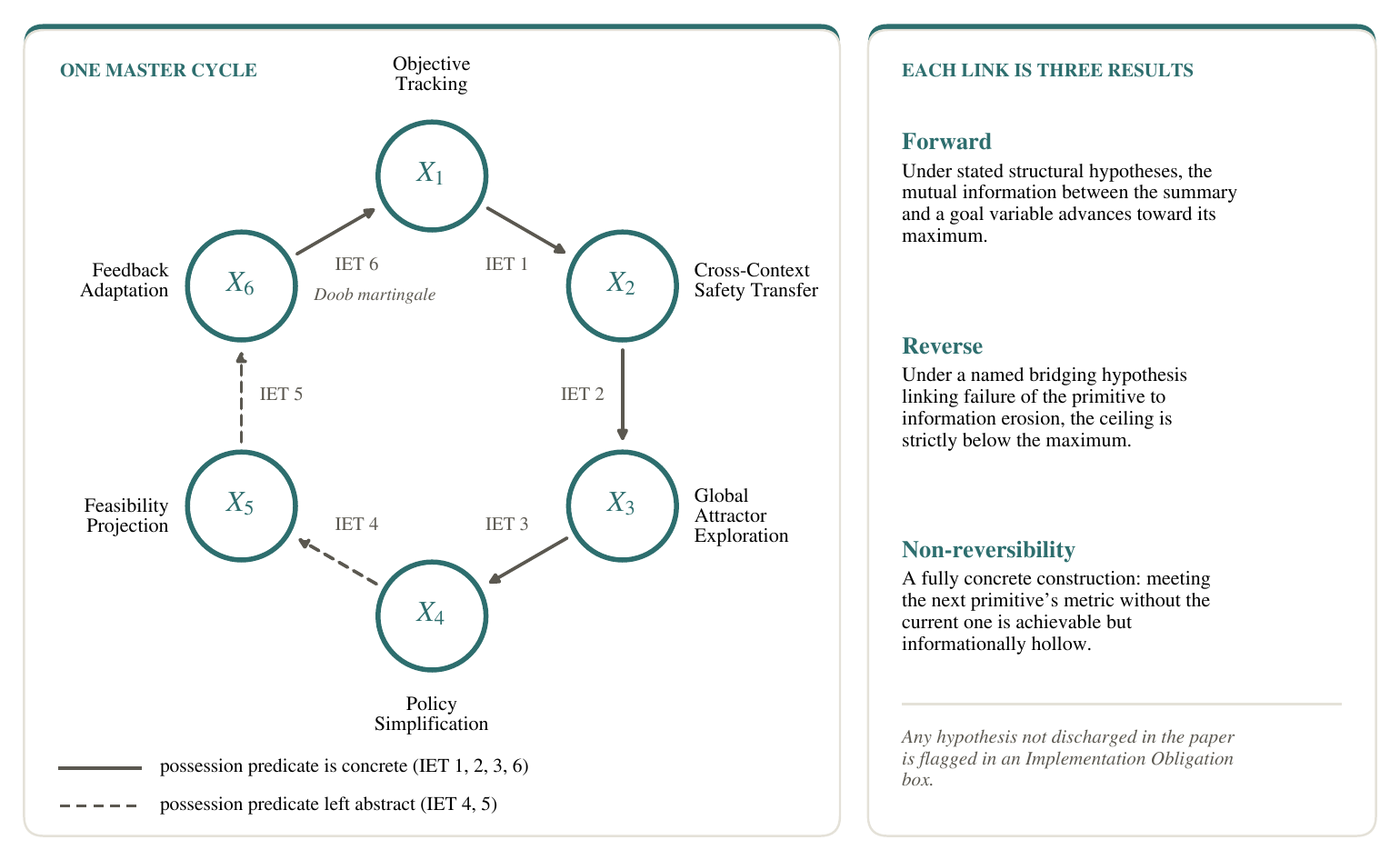
For four links (IET 1, 2, 3 and 6) the possession condition is concrete. For two (IET 4 and 5) the paper states the structure and leaves the possession condition abstract, naming what an implementer would have to supply. The sixth link closes the cycle through a Doob martingale, so the convergence argument over repeated cycles is itself machine-verified.
Part III is conditional by design. Every hypothesis the paper does not discharge is flagged in an Implementation Obligation box at the point where it is used. Each box states what a concrete algorithm, environment and goal variable would need to show before the result could be invoked. The paper claims no particular algorithm succeeds, that possessing all six guarantees success, or that a single universal closing move exists. It proves that the chain's logical architecture is sound and states which further choices would close each link.
Floor and ceiling
Necessity is a floor. It holds whatever the decision-maker wants, because it needs no goal variable and no opinion about what winning means. Necessity is the floor on which everything else stands, and strength above it does not make up for a capability missing from it. Sufficiency is a ceiling. It says what a specific approach can achieve, and achieving something requires first naming what is being optimised.
That naming is a domain deciding what it wants. An investment mandate, a client engagement and an insurance policy book each set a different ceiling on the same floor. So sufficiency for any one organisation needs two things: that organisation's own definition of success, and case-specific mathematical work that closes the Implementation Obligations for it.
What this means for a verdict
An assessment under this field addresses the floor. It asks whether a structure possesses a mechanism that performs each function that the situations it faces make necessary, as set out in the kind of verdict. It does not say the structure is sufficient, and a verdict read as a sufficiency claim has been misread. Error theory lists this as one of the four ways an assessment goes wrong.
Both halves can be examined. The floor is machine-verified, and audit it yourself shows how to read the statements and definitions. The bridge is conditional by design, and it is applied to a case by closing its Implementation Obligations for that case. Verification tiers says what kind of support each claim here has.
| The field | |
|---|---|
| Pages | The QuestionField definitionClass CWhy a POMDPNecessity and sufficiencyVerification tiersAudit it yourselfMethodologiesCompetenceError theoryThree-party verificationAdjacent fields |